
Rationally Irrational
On people, our tools, and why we can’t resist arguing with both.

I’m not afraid of AI.
That seems to confuse people—which I think says more about us than it does about the technology.
Let me be clear: I’m not mesmerized by it. I don’t think it’s sentient. I don’t think it’s plotting. And I don’t think it’s coming for my job—mostly because part of my job requires my physical presence, and some of my job involves wrestling with a shit ton of obstacles (AI don’t want to fool with that!).
What I do believe is this:
Humans are the most rationally irrational creatures on earth.
We are wildly complex and surprisingly simple—often at the same time.
We design systems based on logic, then use them emotionally. We demand precision, then make decisions based on gut instinct, emotion, or whether we’ve eaten recently. We insist on control, then try to hand it off the second something requires too much effort.
AI didn’t invent that contradiction.
It just brought it into sharper contrast.
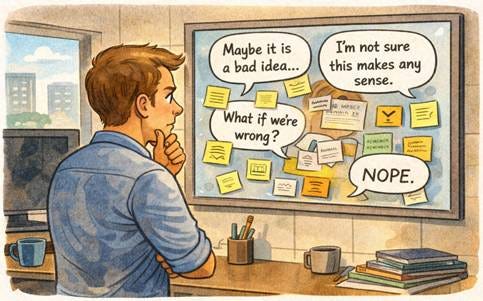
Some people talk about AI as though it’s a monster under the bed. Others treat it like a miracle cure—rub it on everything and see what happens. Both groups are missing the big picture.
AI isn’t thinking.
It’s reflecting.
It doesn’t know things—it recognizes patterns. It doesn’t have opinions—it regurgitates ours. It doesn’t create meaning—it learns it from us, hands it back, and waits.
And that’s the part that gets uncomfortable.
Not because AI is so smart.
But because it’s so familiar.
It talks like us. Argues like us. Explains like us. Sometimes even hedges like us. And when a tool starts sounding human, humans immediately start squirming—
“Is this going to replace us?”
“How will I know what’s real anymore?”
“How am I supposed to make a living?”
Those aren’t technology questions.
Those are identity questions.
I was reminded of this recently in the least technical way possible.
I watched a friend of mine argue—passionately—with her GPS.
Not once did she turn it off.
Not once did she stop following directions.
She just kept driving… while yelling at the thing actively getting her where she wanted to go.
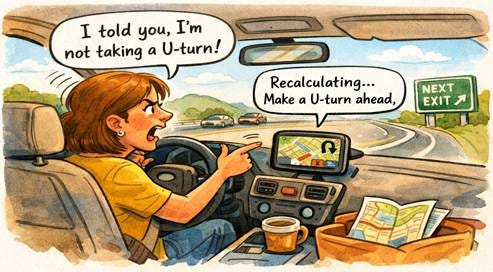
That’s us in a nutshell.
We don’t reject tools—we argue with them while often grudgingly going along with them. We rely on them but insist we could do it on our own if we had to. We want convenience without admitting dependence or laziness.
We’ve always used tools to augment our natural abilities. Pens. Typewriters. Calculators. Spellcheck. GPS. None of these made us less human. They just freed us up to focus on different work and different parts of the human experience.
AI is no different—except it showed up all at once and skipped the polite introduction.
So now we argue about authorship. Originality. About whether assistance invalidates the result.
Which is rich, considering humans have been borrowing from one another since the first guy said, “Hey, watch this.”
I use AI the same way I use an editor or a sharp conversation partner—to catch blind spots, bounce ideas, tighten things up.
But it doesn’t know my thoughts.
It doesn’t know my people.
It definitely doesn’t know my stories.
And it sure as hell doesn’t know about banana pudding.
It knows language about those things.
I know what they mean, how they feel, how they taste, what emotions they conjure up.
That difference matters.
What we’re really dealing with isn’t a technological crisis. It’s a cultural one. We’re wrestling with what counts as “ours” in a world where collaboration—human or otherwise—is unavoidable.
And if history teaches us anything, humans have never been great at sharing.
We want credit and convenience.
Control and ease.
Originality and shortcuts.
Rationally irrational.
AI doesn’t break that balance.
It just holds up a mirror—and we’re still deciding how we feel about that reflection.
I’m not afraid of AI.
I’m far more interested in our reaction to it.
If you enjoy essays that mix humor, observation, and the occasional uncomfortable truth, subscribe to The Condition.
No algorithms harmed here. Just us humans second-guessing the latest tool, as usual.